

Sailing with pets — are you ready?
This page is an honest decision check before you commit.
Sailing with pets changes the nature of boating. Space, routes, emergency response, and daily routines all shift once an animal comes aboard.
Sailing with a pet is not just
sailing plus a pet.
This page helps you decide whether sailing with a pet is appropriate for:
● your pet
● your boat
● your intended travel
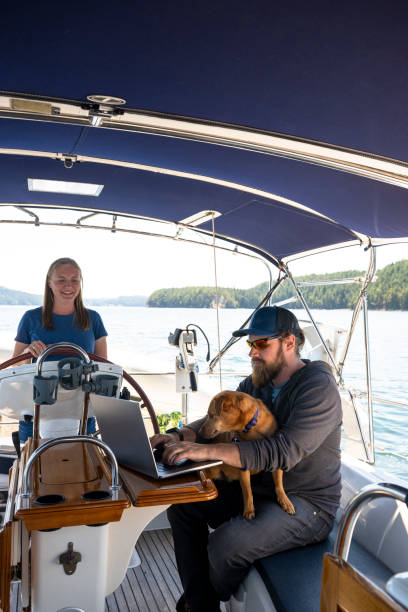
The realities of life at sea with pets
Your boat becomes their entire world
At sea, pets cannot leave when conditions worsen.
They rely completely on you for:
● physical safety
● temperature regulation
● mental stimulation
● medical care
● emergency survival
Ask yourself honestly: can your boat support this in all conditions you plan to sail in?
Weather, motion, heat, and confinement
Pets respond very differently to life at sea.
At sea, pets are exposed to:
● continuous movement
● noise and vibration
● heat build-up
● limited space
● restricted ability to escape stress
Your responsibility is not to hope they will adapt, but to assess whether they can.
Travel restrictions and loss of spontaneity
With a pet aboard, travel becomes planned.
This may include:
● border entry restrictions
● expiring documentation
● quarantine risk
● limited shore access
● complex emergency evacuation
● reduced access to veterinary care in remote areas
Travel choices become constrained when another life depends on you
Is your pet suited to sailing life?
Not all pets cope well with long-term sailing.
Temperament matters more than breed
Consider:
● anxiety and stress response
● adaptability to change
● noise sensitivity
● curiosity versus fear
● trainability
● independence
A calm rescue cat may cope better than a highly strung dog. There are no guarantees.
Health & age considerations
Think long-term:
● chronic conditions
● medication access
● mobility limitations
● heat tolerance
● wound and infection risk
● emergency response constraints
Older or medically fragile pets require significantly more planning and acceptance of limits.
Is your boat realistically suited?
Boat size matters less than layout, safety, and recovery capability.
You should be able to answer “yes” to questions such as:
● Can the boat be secured to prevent falls or escape?
● Can my pet move safely between key areas?
● Can I recover my pet from the water?
● Is there reliable shade and ventilation?
● Is there a protected toileting area?
● Can I isolate my pet during storms or repairs?
If the answer is “not yet”, that does not mean “never”.
It means not without deliberate preparation.
Emergency responsibility
This is the factor most people underestimate.
You must consider whether you could manage:
● a pet overboard
● serious injury offshore
● heatstroke or poisoning
● medical decisions in foreign ports
● situations where help is delayed
If reading this feels uncomfortable, that reaction is valid.
It is information.
Self-assessment
Ask yourself honestly:
● Am I willing to plan passages around my pet’s safety?
● Can I afford veterinary emergencies abroad?
● Will I delay, reroute, or abandon plans if my pet needs it?
● Can I physically lift and manage my pet in an emergency?
● Is my pet adaptable enough for this environment?
● Can my boat be modified to meet these needs?

Uncertainty here is not a reason to push on.
Your next step
If you are unsure whether sailing with your pet is appropriate, Pause here.
and revisit this decision after careful consideration.
If you are confident this is the right choice and accept the responsibility:
Emergency guidance is not a substitute for veterinary advice.
If you can contact a vet, do so as soon as possible.
