

Emergency & Safety Readiness
Training readiness is about whether your pet has learned the skills needed to travel safely.
Good health and good setup are not enough if your pet does not understand what to do in new or changing environments.
This category focuses on the behaviour skills that help pets move safely and cope in vehicles, yachts, campsites, and unfamiliar places.
These skills also support safety during unexpected situations, where pets may need to be handled or controlled quickly.
This includes:
● toilet and hygiene behaviour
● movement and position skills
● settling and rest skills
● motion and noise tolerance
● handling and control acceptance
● safety boundaries and awareness
Training develops gradually. Skills should be reliable in calm conditions before adding movement, noise, or distraction.
Some training skills also support emergency situations where pets may need to be guided, restrained, or moved quickly.
Training & Behaviour Readiness
Training readiness is about whether your pet has learned the skills needed to travel safely.
Good health and good setup are not enough if your pet does not understand what to do in new or changing environments.
This category focuses on the behaviour skills that help pets move safely and cope in vehicles, yachts, campsites, and unfamiliar places.
These skills also support safety during unexpected situations, where pets may need to be handled or controlled quickly.
This includes:
● toilet and hygiene behaviour
● movement and position skills
● settling and rest skills
● motion and noise tolerance
● handling and control acceptance
● safety boundaries and awareness
Training develops gradually. Skills should be reliable in calm conditions before adding movement, noise, or distraction.
Some training skills also support emergency situations where pets may need to be guided, restrained, or moved quickly.
Training & behaviour readiness areas
First Aid Training
Do I have the skills to provide first aid for my pet in an emergency?
Prepare & learn the first-aid skills needed to respond to a pet emergency — wherever you are
First Aid Training readiness
Builds reliable toileting in travel environments.
🌍 All Travel Environments

What must be in place
✅
What can go wrong if not in place
⚠️
What new risks or pressures this may create
ℹ️️
Related systems to check
● tether points & attachment points ● barriers & separation between areas ● safe escape routes
Ready to work on this area?
Find guides, checklists, how-to guidance and pathway-specific advice.
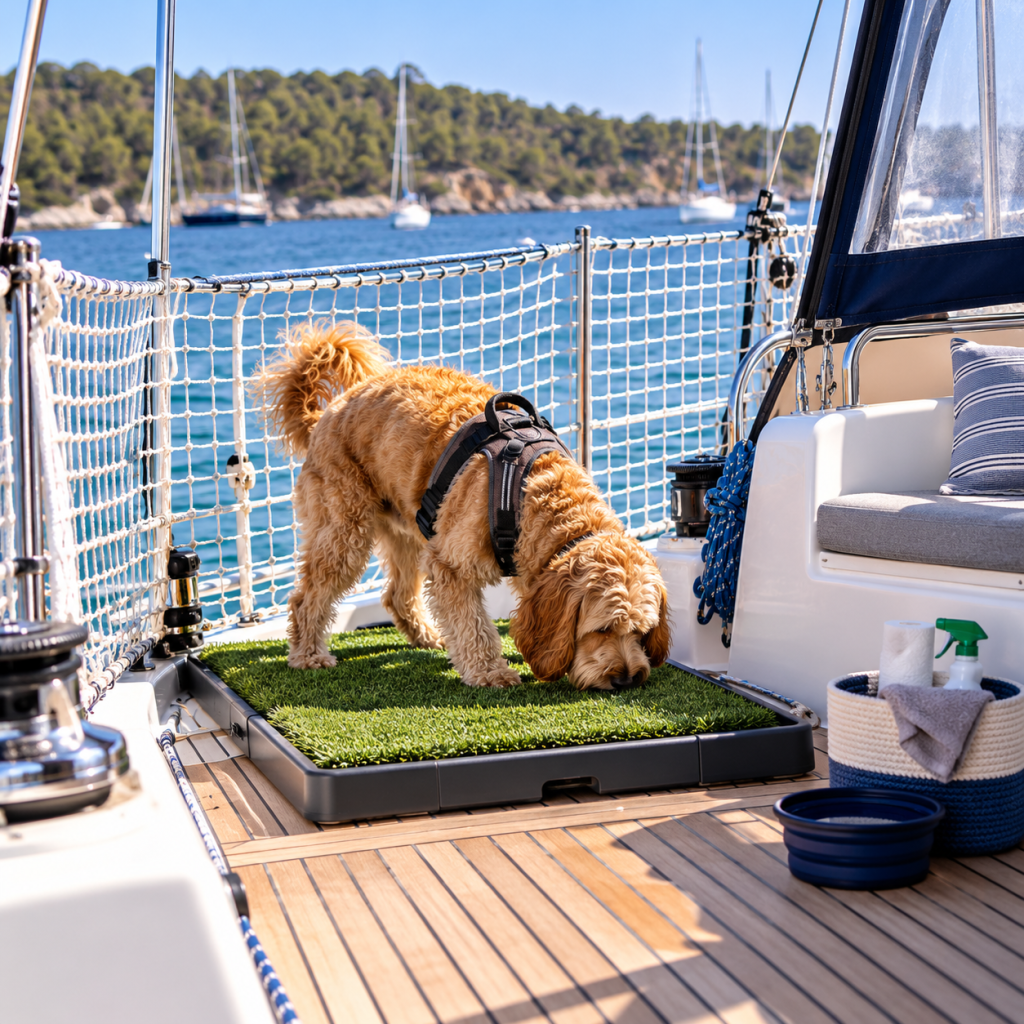
Toilet & hygiene training
Can my pet toilet reliably in the places and conditions we will travel in?
Teaching your pet where and when to toilet in travel environments.
Toilet & hygiene readiness
Builds reliable toileting in travel environments.
🌍 All Travel Environments
What must be in place
✅ A clear toileting cue or routine
✅ Acceptance of the travel toilet surface (grass, mat, turf, litter, ground area)
✅ Ability to toilet on lead where needed
✅ Ability to toilet in new locations
✅ Tolerance for small or slightly moving areas
✅ Predictable holding between opportunities
✅ No panic linked to noise or motion
✅ Routine that works in different places
✅ Toileting without
✅ Ability to toilet despite mild weather changes
What can go wrong if not in place
⚠️ Refusal to toilet causing stress or discomfort
⚠️ Accidents inside living areas
⚠️ Hygiene problems in confined spaces
⚠️ Stress from holding too long
⚠️ Disruption to travel plans
What new pressures training may create
ℹ️️ Routine becoming too rigid
ℹ️️ Surface preference becoming too narrow
ℹ️️ Temporary regression in new environments
Related systems to check
● tether points & attachment points ● barriers & separation between areas ● safe escape routes
Ready to work on this area?
Find guides, checklists, how-to guidance and pathway-specific advice.
Movement & position skills
Can my pet move safely and stay where they should during activity?
Helping your pet move safely and stay in the right places during activity.
Toilet & hygiene readiness
Builds reliable toileting in travel environments. What must be in place
🌍 All Travel Environments
What must be in place
✅
What can go wrong if not in place
⚠️
What new risks or pressures this may create
ℹ️️
Related systems to check
● tether points & attachment points ● barriers & separation between areas ● safe escape routes
Ready to work on this area?
Find guides, checklists, how-to guidance and pathway-specific advice.
Settling & rest skills
Can my pet relax and rest calmly when nothing is happening?
Teaching your pet to switch off and rest during downtime or travel.
card 4 - detail
Builds reliable toileting in travel environments. What must be in place
🌍 All Travel Environments
What must be in place
✅
What can go wrong if not in place
⚠️
What new risks or pressures this may create
ℹ️️
Related systems to check
● tether points & attachment points ● barriers & separation between areas ● safe escape routes
Ready to work on this area?
Find guides, checklists, how-to guidance and pathway-specific advice.
Motion & noise tolerance
Can my pet cope with vibration, motion, and unfamiliar sounds?
Helping your pet stay calm with vibration, movement, and unfamiliar sounds.
card 5 - detail
Builds reliable toileting in travel environments. What must be in place
🌍 All Travel Environments
What must be in place
✅
What can go wrong if not in place
⚠️
What new risks or pressures this may create
ℹ️️
Related systems to check
● tether points & attachment points ● barriers & separation between areas ● safe escape routes
Ready to work on this area?
Find guides, checklists, how-to guidance and pathway-specific advice.
Safety boundaries & awareness
Does my pet avoid hazards and wait when it matters?
Teaching your pet to respect edges, doors, traffic zones, and other hazards.
card 6 - detail
Builds reliable toileting in travel environments. What must be in place
🌍 All Travel Environments
What must be in place
✅
What can go wrong if not in place
⚠️
What new risks or pressures this may create
ℹ️️
Related systems to check
● tether points & attachment points ● barriers & separation between areas ● safe escape routes
Ready to work on this area?
Find guides, checklists, how-to guidance and pathway-specific advice.
Handling, restraint & emergency control
Does my pet to accept lifting, restraint, and close handling.
Preparing your pet to accept lifting, restraint, and close handling.
card 7 - detail
Builds reliable toileting in travel environments. What must be in place
🌍 All Travel Environments
What must be in place
✅
What can go wrong if not in place
⚠️
What new risks or pressures this may create
ℹ️️
Related systems to check
● tether points & attachment points ● barriers & separation between areas ● safe escape routes
Ready to work on this area?
Find guides, checklists, how-to guidance and pathway-specific advice.
🏞
Continue your readiness
Start with the areas that matter most to your pet & your journey, then review and build on them as circumstances change.
Emergency & Safety Readiness
Emergency readiness is about having the right equipment in place before something goes wrong.
Even with good planning and setup, problems can still happen — especially in remote areas or at sea.
This category focuses on the physical equipment and preparation that allow you to respond safely if normal conditions break down.
This includes:
● recovery equipment
● first aid supplies
● backup control equipment
● identification and tracking
● protection if help is delayed
● evacuation readiness
Training also matters
Emergency equipment works best when your pet is already used to being handled and positioned calmly.
Training skills are covered in Training & Behaviour Readiness, including:
● handling & control
● movement & position skills
Practising in calm conditions improves safety during real emergencies.
Emergency & safety readiness areas
Emergency & safety readiness is organised by the types of situations where you may need equipment quickly.
These areas help you check that the right equipment is in place before you travel — not after something has already gone wrong.
Each area focuses on one type of risk:
● water recovery
● injury
● containment
● separation
● exposure or delay
● evacuation
This allows you to prepare step-by-step while keeping the whole system aligned.
Water recovery & overboard retrieval (yacht)
Can I get my pet safely back onboard if they fall into the water?
Equipment needed to lift, support, and recover your pet from the water safely.
First aid items & stabilisation
Do I have what I need to manage an injury until I reach proper care?
Supplies to manage bleeding, wounds, shock, or basic injury until veterinary care is available.
Emergency control & containment
Can I safely control my pet if they panic, are injured, or won’t cooperate?
Backup equipment to safely restrain or guide your pet if normal handling is not possible.
Finding your pet if separated
Could I locate my pet quickly if we become separated?
Equipment that helps you identify, track, and prove ownership if separation occurs.
Protection if help is delayed
Could my pet stay safe and stable if help is not immediately available?
Equipment needed to maintain safety, shelter, and stability if veterinary care or safe harbour is delayed
Evacuation & handover readiness
Could I leave quickly with my pet, or could someone else take over safely?
Items that allow rapid departure or safe handover to another person.
Owner emergency & pet care readiness
If something happens to me, could someone find, access and care for my pet — even if I cannot tell them myself?
Information and arrangements that allow someone else to locate and care for your pet if an illness, injury or other emergency means you cannot do so yourself.
Emergency & safety readiness modules
Emergency & safety readiness is organised by the types of situations where you may need equipment quickly if normal conditions break down.
These areas help you confirm the right equipment is in place before you travel — not after something has already gone wrong.
Each area focuses on one type of emergency so you can prepare step-by-step and make sure nothing important is missing.
Water recovery & overboard retrieval (yacht)
Manages the equipment needed to get your pet safely out of the water and back onboard.
What must be in place
● A pet recovery kit stored in one known place
● A recovery line long enough to reach the water
● A lifting aid that can support a wet pet’s weight
● An attachment method that does not rely on a collar alone
● A clear and reachable recovery point (stern, transom, or low access point)
● Tools that can be used one-handed if needed
● A non-slip grip aid for wet handling (towel or mat)
● Equipment protected from salt and sun damage
● Spare clips or connectors
● Recovery gear secured so it cannot fall overboard
● A line that is visible in low light or water
What can go wrong if not in place
● You cannot reach or secure your pet in the water
● Your pet becomes too tired before recovery
● Injury during lifting
● You are forced into unsafe positions near the stern
● Delay because equipment cannot be found quickly
What new risks or pressures this may create
● Recovery lines becoming trip hazards if not secured
● Lift gear taking space and needing maintenance
● Extra fittings interfering with normal deck use
Training & familiarity
Equipment works best when pets are used to calm handling before emergencies happen.
See: Training & Behaviour Readiness
● Handling & control
● Movement & position skills
Practising in calm conditions improves safety during real events.
First aid items & stabilisation
Manages first aid supplies so injuries can be stabilised until proper care is available.
What must be in place
● A complete pet first aid kit stored in one location
● Kit protected from heat and water damage
● Bleeding control supplies suited to your pet’s size
● Wound cleaning supplies stored securely
● Supplies for bites or stings where relevant
● Safe basic tools (scissors, tweezers)
● Paw and nail injury coverage
● Eye or skin rinse solution
● A towel, sling, or blanket for lifting support
● A clean surface barrier for roadside or sand use
● Medication protected from heat or freezing
● Kit accessible without unloading everything
What can go wrong if not in place
● Bleeding not controlled quickly
● Wounds becoming contaminated
● Reaction to bites worsening
● Injury made worse during lifting
● Delays because supplies are hard to find
● Damaged supplies due to heat or leaks
What new risks or pressures this may create
● Large kits taking space and being left behind
● Poor organisation slowing access
● Liquids leaking if not stored properly
Training & familiarity
Equipment works best when pets are used to calm handling before emergencies happen.
See: Training & Behaviour Readiness
● Handling & control
● Movement & position skills
Practising in calm conditions improves safety during real events.
Emergency control & containment
Manages backup control equipment if normal handling is not possible.
What must be in place
● a backup lead that can be fitted quickly (slip lead or equivalent)
● a backup harness or secure attachment option if a collar fails
● a short control tether for tight spaces (cockpit, roadside, waiting areas)
● a temporary containment option sized to your pet (soft crate, pen, barrier) where used
● a safe grab method that does not require hands close to teeth (handle or lead setup)
● spare clips and connectors that match your existing gear
● a fixed storage spot close to the main exit point (door / companionway / cockpit access)
● control gear secured so it cannot fall into moving parts, water, or traffic areas
● no loose loops that can snag when moving quickly
● a simple way to separate pets if travelling with more than one (divider, gate, second lead)
Failure Exposure (if absent)
● the pet bolts during chaos, traffic, or crowded movement
● you cannot move an injured pet safely
● control requires wrestling, increasing bite and injury risk
● containment fails when primary gear breaks
● delay while searching for basic control tools
Trade-offs & Secondary Exposure
● loose control gear becomes a snag and trip hazard
● spare gear stored too deep is effectively not carried
● stronger hardware adds weight and can bruise if it swings free
● temporary containment takes space and needs a fixed stow position
Training & familiarity
Equipment works best when pets are familiar with handling and positioning before emergencies occur.
See: Training & Behaviour Readiness
● Handling & control
● Movement & position skills
Practising in calm conditions improves safety during real events.
Finding your pet if separated
Manages identification and tracking so your pet can be found and returned.
What must be in place
● Visible ID that stays readable when wet or dirty
● A second copy of ID stored with emergency gear
● Night visibility (light or reflective marking) where relevant
● Tracking device where used, fitted securely
● Tracking device protected from water and impact
● Spare battery or charging method where relevant
● Contact details formatted correctly for travel
● Strong attachment points for tags and trackers
● Carriers or crates labelled with contact details
● ID and tracker checked before departure
What can go wrong if not in place
● Pet cannot be identified quickly
● Ownership cannot be proven
● Pet lost at night
● Tracker fails due to flat battery or damage
● Delays while searching for records
What new risks or pressures this may create
● Tags or lights snagging if poorly fitted
● Trackers adding bulk
● Relying on one tracker as a single point of failure
Protection if help is delayed
Manages heat, cold, wet conditions, and delays when help is not immediately available.
What must be in place
● Shade that works when parked or anchored
● Cooling support suitable for your climate
● Insulation and wind protection for cold conditions
● Reliable water supply and delivery method
● Paw protection for hot or sharp surfaces
● A dry resting surface
● A way to contain your pet while managing the situation
● Gear stored dry and ready to use
● Equipment accessible without unpacking everything
● Basic hygiene supplies
● Small emergency food reserve where needed
What can go wrong if not in place
● Overheating during delays
● Cold stress in wind or rain
● Dehydration
● Paw burns or cuts
● Pet forced to rest on unsafe ground
What new risks or pressures this may create
● Bulky gear taking space
● Wet gear causing mould if not dried
● Insulation trapping heat if misused
● Booties or wraps snagging if poorly fitted
Evacuation & handover readiness
Manages grab-and-go equipment so you can leave quickly or hand over safely.
What must be in place
● A pet grab bag stored near an exit
● Spare lead and harness inside the bag
● Compact water and feeding setup
● Essential medication stored safely
● Copies of ID and medical records in waterproof sleeve
● Simple written care note
● Sling or blanket carry option
● Small light source where relevant
● Bag secured so it cannot move under braking
● Bag simple enough to keep updated
● Control gear accessible without searching
What can go wrong if not in place
● Delayed evacuation
● Pet moved without proper control
● Medication or records left behind
● Third party cannot assist properly
● Loose bag becoming dangerous during movement
What new risks or pressures this may create
● Grab bags becoming cluttered
● Expired medication or food if not checked
● Storing near exits exposing bag to water or dust
● Heavy bags slowing movement
Training & familiarity
Equipment works best when pets are used to calm handling before emergencies happen.
See: Training & Behaviour Readiness
● Handling & control
● Movement & position skills
Practising in calm conditions improves safety during real events.
Owner emergency & pet care readiness
Makes sure someone can find, access and care for your pet if something happens to you.
What must be in place
● A clear way for others to know that you are travelling with a pet, even if you cannot tell them yourself
● Emergency pet information that can be found if you are unconscious or otherwise unable to communicate
● Information showing where your pet is if they are not with you
● Contact details for anyone travelling with you who could take over your pet’s care
● A separate emergency contact if nobody travelling with you is available
● Vessel name and location, vehicle details, accommodation details or other information needed to find your pet
● Clear information on how someone can gain appropriate access to your pet if you cannot return
● Essential feeding, medication, medical and behavioural information
● Veterinary contact details and relevant medical information
● Identification details that clearly match the correct pet
● Information available without relying entirely on internet or mobile access
● A simple way to keep your location, contact and emergency information current as you travel
● Additional arrangements if you are travelling alone
What can go wrong if not in place
● You are unconscious or unable to communicate and nobody knows that a pet is involved
● Your pet is left alone because nobody knows where they are
● People know you have a pet but cannot locate or reach them
● Emergency services or others assume another traveller is caring for your pet
● Someone reaches your pet but does not know about medication, medical conditions or essential care
● Nobody knows who to contact to take over your pet’s care
● Emergency contact details are incorrect or out of date
● Access is delayed because keys, access information or vessel, vehicle or accommodation details cannot be found
● Your pet remains aboard, in a vehicle, at accommodation or elsewhere for longer than is safe
● A solo traveller’s pet has nobody automatically available to take over their care
● Important information cannot be accessed because there is no mobile signal, internet connection or access to your phone
What new risks or pressures this may create
● Emergency information becoming outdated as your location or travel arrangements change
● Personal or access information being visible to people who do not need it
● Relying on one emergency contact who may be unavailable
● Relying on a phone, app or online record that may be inaccessible during an emergency
● Access arrangements creating security risks for a vessel, vehicle or accommodation
● Too much information making essential instructions difficult to find quickly
● Different arrangements being needed as you move between a vessel, vehicle, accommodation or other locations
Travelling with others
If you are travelling with other people, make sure their contact details can be found and that they know enough about your pet to take over or arrange care if something happens to you.
Do not rely on them being with you when the emergency happens. You may be ashore, away from your vehicle or accommodation, or otherwise separated when you need help.
Travelling alone
When travelling alone, your emergency arrangements must work without you.
If you are unconscious or otherwise unable to communicate, another person still needs a way to:
● identify that a pet is involved
● find out where your pet is
● identify the correct vessel, vehicle, accommodation or other location
● gain appropriate access to your pet
● find essential medication, medical and care information
● contact someone who can take over your pet’s care
For solo sailing, consider what happens if you are taken away from the vessel and your pet remains aboard, including at a marina, on a mooring or at anchor.
For solo overland travel, consider what happens if you are taken away and your pet remains in a car, camper, motorhome, accommodation or another location.
Your arrangements should not depend entirely on you being conscious, having your phone available, or having an internet connection.
Related readiness
See: Training & Behaviour Readiness
● Handling & control
● Movement & position skills
Your pet grab bag, evacuation equipment and physical handover supplies are covered under Evacuation & Handover Readiness.
Pet identification and tracking equipment are covered under Finding Your Pet if Separated.
